
If you run your own limited company, you can choose how to pay yourself. For most directors, the answer is a mix of salary and dividends. Here's how it works for 2024/25.
Salary
A salary is a business expense, so it reduces your company's Corporation Tax. The two levels most directors consider are:
£9,100 a year: no employer or employee National Insurance, and it still counts towards your State Pension
£12,570 a year: uses your full Personal Allowance. There's a little employer National Insurance (13.8% on the amount over £9,100), but the Corporation Tax saving usually outweighs it
If your company can claim the Employment Allowance (for example, because it has another employee on the payroll), a higher salary can make even more sense.
Dividends
Dividends are paid from profits after Corporation Tax. They aren't a business expense, but they're taxed at lower rates than salary:
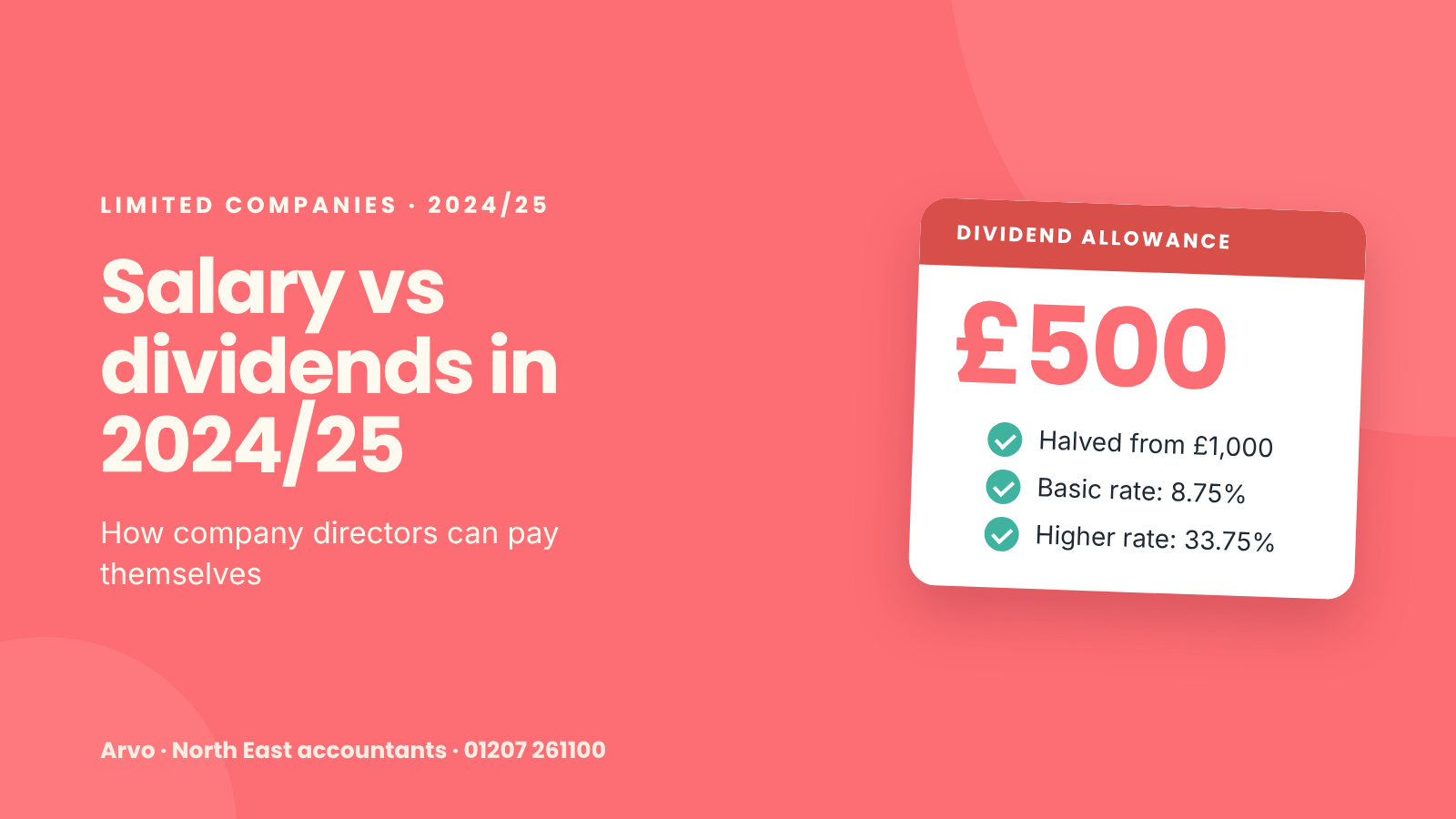
£500 tax-free dividend allowance (down from £1,000)
8.75% in the basic rate band
33.75% in the higher rate band
39.35% for additional rate taxpayers
Corporation Tax
19% on profits up to £50,000
25% on profits over £250,000
Marginal relief in between
An example
A director with a salary of £12,570 and dividends of £37,700 stays within the basic rate band. After the £500 allowance, the dividend tax is around £3,255, with no employee National Insurance to pay.
Things to check
Your company must have enough profit to pay a dividend
Keep board minutes and dividend vouchers
Think about your total income if you're near £50,270 or £100,000
Related reads
How Arvo can help
We'll work out the best salary and dividend mix for you, run your payroll and prepare the paperwork for every dividend.
Find out more about our director pay and tax planning service.
Get in touch to arrange a free, no-obligation chat, or call us on 01207 261100.