
If you rent out a property, you pay tax on your profit, not your total rent. So claiming every allowable expense matters.
What you can claim
Letting agent and management fees
Repairs and maintenance, such as fixing a boiler, repainting or replacing broken windows
Insurance, including landlord and buildings insurance
Ground rent and service charges
Utility bills and council tax, if you pay them rather than the tenant
Replacing furniture and appliances, like a sofa, fridge or carpets (but not the first purchase)
Accountancy fees
Travel to the property for business reasons
Safety certificates, like gas safety checks and EPCs
What you can't claim
Improvements, such as an extension or a loft conversion. These may reduce Capital Gains Tax when you sell
Mortgage capital repayments
Your own time
The cost of furnishing a property for the first time
Repair or improvement?
Replacing like for like is usually a repair. Upgrading is often an improvement. Replacing single-glazed windows with double glazing is generally treated as a repair, because it's the modern equivalent. A new kitchen of a much higher standard may be partly an improvement.
Mortgage interest
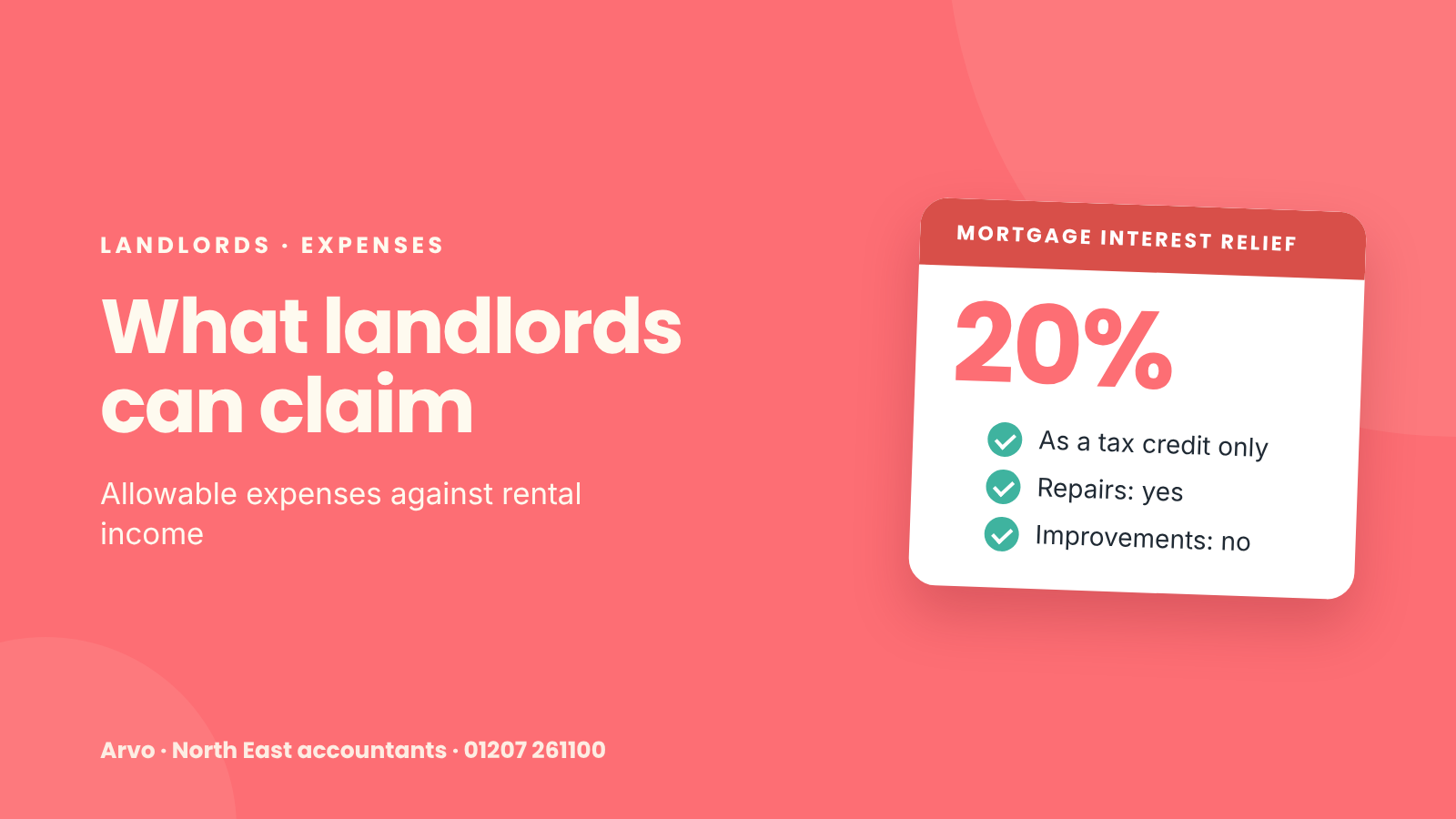
If you own the property personally, you can't deduct mortgage interest from your rental income. Instead, you get a tax credit of 20% of the interest. That means higher rate taxpayers effectively get less relief than they pay.
This doesn't apply to properties owned by a limited company, which can deduct interest in full.
Small amounts of rent
If your rental income is under £1,000 a year, the property allowance means it's tax-free.
Related reads
Furnished holiday lets: the tax breaks due to end in April 2025
Stamp Duty changes on 1 April 2025: what buyers need to know
Buy-to-let and mortgage interest: why the 20% rule still bites
How Arvo can help
We'll make sure you claim every allowable expense, handle the mortgage interest rules and file your tax return.
Get in touch to arrange a free, no-obligation chat, or call us on 01207 261100.