
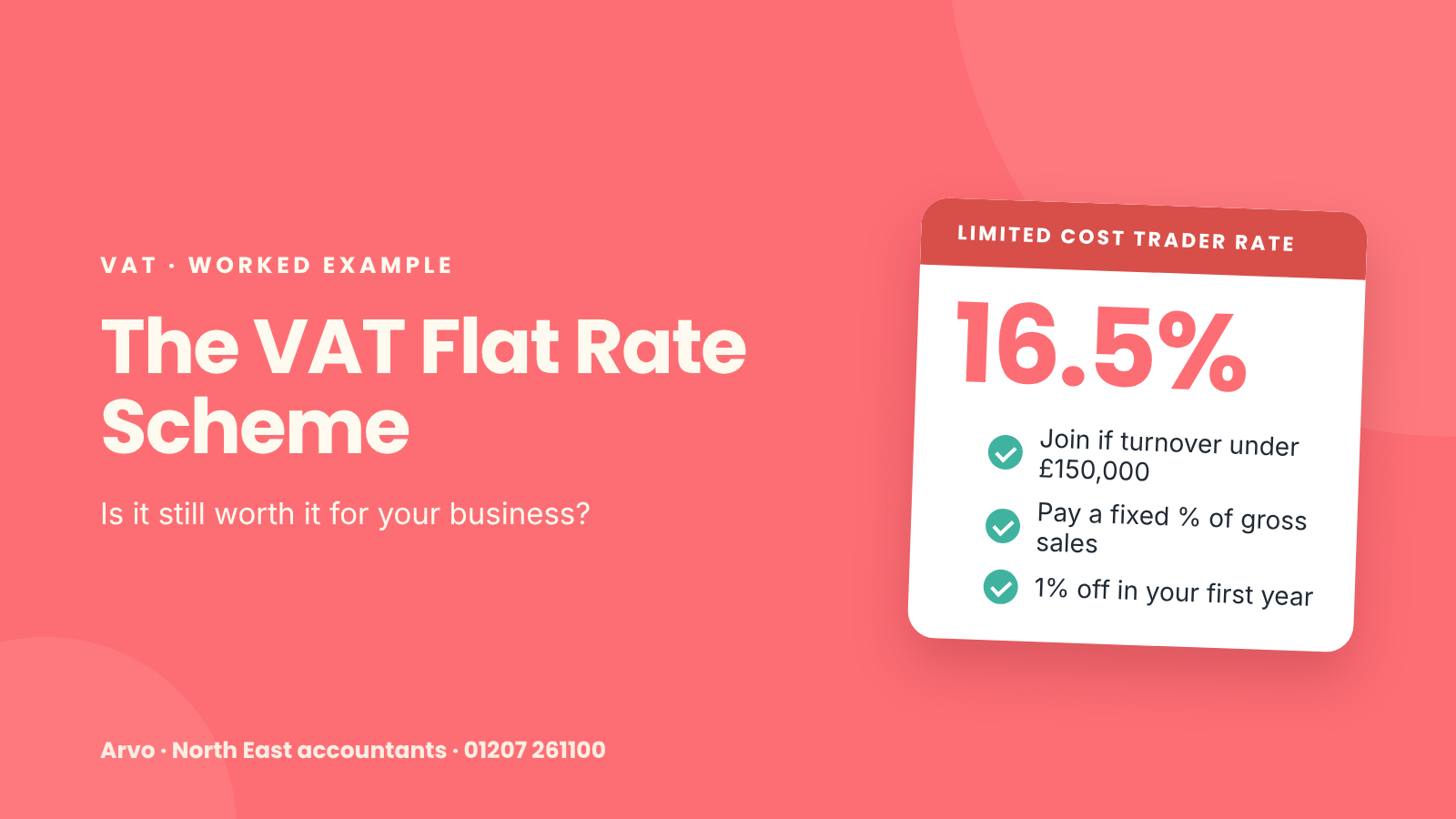
The VAT Flat Rate Scheme lets small businesses pay VAT as a fixed percentage of their sales, instead of working out VAT on every purchase. It can save time, and sometimes money. But for many businesses, it's no longer the bargain it was.
How it works
You charge customers VAT at the normal rate, usually 20%
You pay HMRC a fixed percentage of your VAT-inclusive turnover
You don't reclaim VAT on most purchases, except some capital items over £2,000
The percentage depends on your business sector
You get 1% off in your first year of VAT registration
You can join if your taxable turnover is £150,000 or less a year, excluding VAT.
The limited cost trader trap
If you spend very little on goods, you're a limited cost trader and must use a rate of 16.5%, whatever your sector. You're a limited cost trader if your spending on goods is less than:
2% of your VAT-inclusive turnover, or
£1,000 a year
Services, rent, fuel for vehicles and capital items don't count as goods.
A worked example
A consultant has sales of £60,000 plus VAT, so £72,000 including VAT. They spend £2,500 plus VAT on costs.
Standard VAT: £12,000 output VAT, less £500 input VAT = £11,500
Flat rate as a limited cost trader: 16.5% of £72,000 = £11,880
They'd pay £380 more on the Flat Rate Scheme.
Who it still suits
Businesses that buy enough goods to avoid the 16.5% rate, in a sector with a lower flat rate
Businesses with very few VAT-able costs that value simpler records
Some businesses in their first year, thanks to the 1% discount
Check every year
Your spending changes, so check whether you're a limited cost trader each VAT period. You can leave the scheme at any time.
Related reads
How Arvo can help
We can compare the Flat Rate Scheme with standard VAT using your real figures, and switch you if it's costing you money.
Find out more about our VAT returns service.
Get in touch to arrange a free, no-obligation chat, or call us on 01207 261100.