
If you run your business through a limited company, the money in the company isn't yours to spend as you like. You need to take it out in a tax-efficient way. For most directors, that means a small salary plus dividends.
Why salary and dividends?
Salary is a business expense, so it reduces your company's Corporation Tax. But above certain levels, it brings National Insurance for you and the company.
Dividends are paid out of profits after Corporation Tax. There's no National Insurance on them, and they're taxed at lower rates than salary.
Getting the mix right can save hundreds, or even thousands, of pounds a year.
What's changed for 2026/27
From 6 April 2026, dividend tax went up by two percentage points:
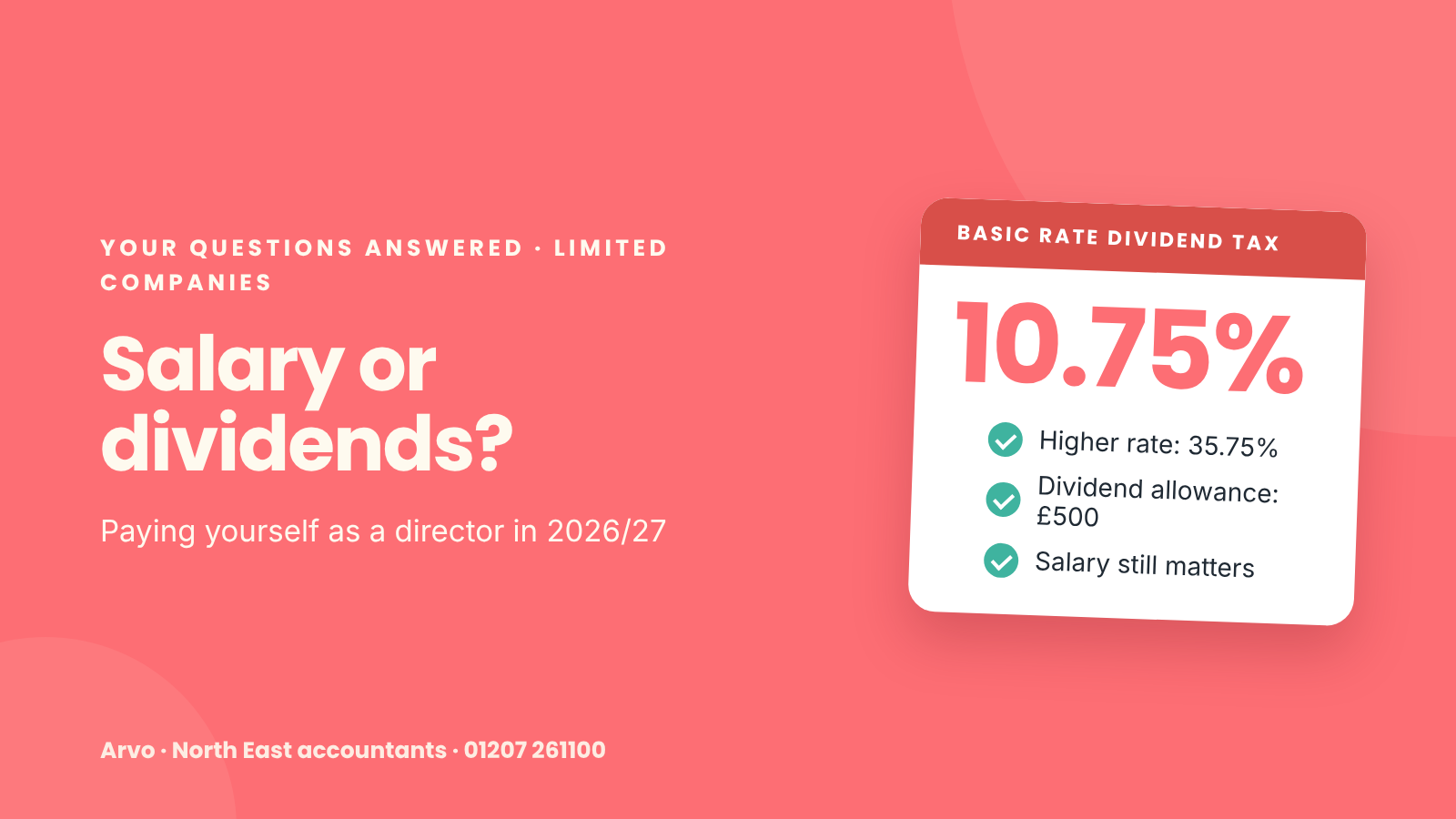
10.75% in the basic rate band (up from 8.75%)
35.75% in the higher rate band (up from 33.75%)
39.35% in the additional rate band (unchanged)
The tax-free dividend allowance stays at just £500.
How much salary?
The right salary depends on your situation, but common choices are:
Around £6,708 or a little more. That's the Lower Earnings Limit, which keeps your State Pension record building without paying employee National Insurance.
Up to £12,570, your Personal Allowance. This often works well if your company can claim the Employment Allowance, for example because it has other employees, so there's no employer National Insurance to pay.
For a company where the director is the only person on the payroll, the Employment Allowance isn't available. Then the best salary depends on your company's Corporation Tax rate, and it's worth running the numbers.
Rules to get right
Dividends can only come from profits. If there aren't enough retained profits, a "dividend" can become an overdrawn director's loan, with tax charges of its own.
Paperwork matters. Each dividend needs board minutes and a dividend voucher.
Watch the £100,000 mark. Over £100,000 of income, you lose part of your Personal Allowance, so your marginal tax rate is very high.
Think about your spouse or partner. If they own shares and work in the business, there may be ways to share income, but this needs care.
Worth reviewing every year
Tax rates change, and so do your profits. A quick review each spring, before the new tax year, makes sure you're not paying more than you need to.
How Arvo can help
We're a local accountancy practice in Stanley, County Durham, and we work with limited companies across the North East. We'll work out the best salary and dividend mix for you and handle the payroll and paperwork.
Get in touch to arrange a free, no-obligation chat, or call us on 01207 261100.